









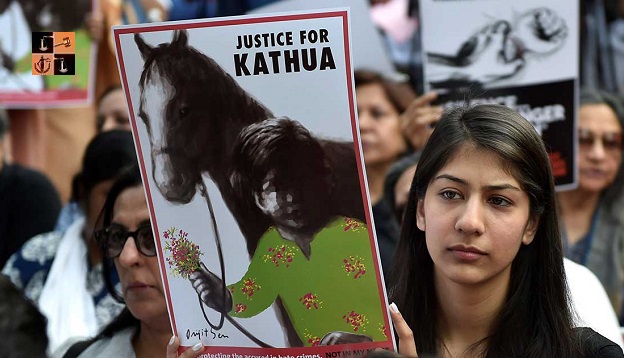
The Supreme Court in the matter of heinous Rape and Murder of a minor girl in Kathua region of Jammu & Kashmir in 2018, has allowed the appeal of the State and rejected the juvenility claim of the accused on the ground of Medical Report.
The Division Bench of Justice Ajay Rastogi and Justice JB Pardiwala observed that there is no cogent and convincing documentary evidence on record as regards the date of birth or age of the respondent accused on the date of the alleged crime then there is no good reason for us not to look into or ignore the medical report prepared by the Special Medical Board which is on record.
The Court conluded that the Medical Report shall be taken as the conclusive evidence of age of the accused.
The Court at the oustet stated that Sub-rule (3) of Rule 74 makes it abundantly clear that in the absence of the certificates mentioned in subclause (i) to (iii) or in the event of any contradiction arising therefrom, the 34 authority deciding the issue of age may refer the matter to a duly constituted medical board which, in turn, would record its findings and submit to the Juvenile Justice Board.
Having a look at the same, the Court was not in doubt that there exists discrepancies in the certificates on record disclosing the date of birth of the respondent.
Noting that even if the documents are found to be prima facie correct, there may be facts and circumstances to push in the direction of the inquiry to satisfy for correctness of the claim, the Court referred to Abuzar Hossain @ Gulam Hossain Vs. State of West Bengal, 2012 Latest Caselaw 584 SC wherein it was held that when any claimant or any of the parents or siblings in support of the claim of the juvenility raised for the first time in appeal or revision depends on mere affidavits, it shall not be sufficient to justify the inquiry for determination of age unless there exist circumstances which cannot be ignored.
Rejecting repsondent's argumnent with regard to leinancy on discrepencies, the Court rather observed:
"The correct way of looking at the core issue is to closely examine whether there is any cogent or convincing evidence as regards the correct date of birth of the respondent accused and after ascertaining the same, reach to an appropriate conclusion. If, there is any doubt in this regard, there is no good reason why the matter should not be referred to a duly constituted medical board which shall, in turn, record its findings and submit to the Juvenile Justice Board. The word “may” should be read as “shall” having regard to the very object of sub-rule (3) of Rule 74."
To substantiate the above, the Court referred to Smt. Bachahan Devi & ANR Vs. Nagar Nigam, Gorakhpur & ANR, 2008 Latest Caselaw 120 SC wherein it was established that it is a well settled principle of interpretation that the word ‘may’ when used in a legislation by itself does not connote a directory meaning. If in a particular case, in the interests of equity and justice it appears to the court that the intent of the legislature is to convey a statutory duty, then the use of the word ‘may’ will not prevent the court from giving it a mandatory colour.
The Court went on to deeply deliberate on the relevant provisions of the Juvenile Justice Act- Section 8 which provides for the procedure to be followed, when the claim of juvenility is raised and Section 48 which talks about presumption and determination of age. It found that it was relevant to note is that in both the Sections, the word ‘shall’ has been used.
The Court then rejected the argument that the Special Medical Board should not have been constituted as it palesd into insignificance because the Special Board was constituted under the directions issued by the High Court.
It clarified that Darga Ram @ Gunga Vs. State of Rajasthan was rendered in the peculiar facts & circumstances of that case & any attempt of generalizing the said approach could not be justifiably entertained and mentioned Mukarrab Etc. Vs. State of U.P., 2016 Latest Caselaw 861 SC
"Sub-clause (3) of the aforesaid Rule clearly mandates that while conducting an inquiry about the juvenility of an accused, the Juvenile 44 Justice Board would seek evidence by obtaining the matriculation or equivalent certificates and in the absence whereof the date of birth certificate from the school first attended and in absence whereof the birth certificate given by a corporation or a Municipal authority or a Panchayat. It is made clear by sub-clause (b) that only in the absence of the aforesaid three documents, medical information would be sought from a duly constituted Medical Board which will declare the age of the juvenile or child. Thus, it is only in the absence of the aforesaid documents that the Juvenile Justice Board can ask for medical information/ossification test."
On Counsel for accused's contention to not scrutanize the documents and reliance on Ashwani Kumar Saxena Vs/ State of M.P., 2012 Latest Caselaw 493 SC for the same, the Court mentioned Rishipal Singh Solanki Vs. State of Uttar Pradesh, 2021 Latest Caselaw 587 SC to point out the difference in the procedure under the two enactments, i.e., the Act, 2000 and the Juvenile Justice (Care and Protection of Children) Act, 2015, as to the inquiry into determination of age of the juvenile and also the power to seek evidence, how and when to exercise that power and when to go for the ossification test.
Noting that each case may be dealt with in the light of its own peculiar facts and circumstances while keeping certain principles as the guiding factor in mind as per the above ruling, the Court referred to decisions in Ashwani Kumar Saxena (supra) and Abuzar Hossain @ Gulam Hossain (supra) to highlight the fact that only in the cases where certificates are found to be fabricated and manipulated, the Juvenile Justice Board need to go for medical report and also highlighted the fact that the yardstick for relying on the school certificates may be a bit different.
"Thus, this Court kept in mind the facts and circumstances attached to the production of documents/certificates, as required by the provisions of the Juvenile Justice Act before those documents could be relied upon. In other words, even if the documents are found to be prima facie correct, there may be facts and circumstances to alert the Court to go into the inquiry to satisfy itself as to correctness of the claim", it said.
Notably, the Court noted that it is no doubt true that if there is a clear and unambiguous case in favour of the juvenile accused that he was a minor on the date of the incident and the documentary evidence at least prima facie establishes the same, he would be entitled to the special protection under the Juvenile Justice Act, however, when an accused commits a heinous and grave crime like the one on hand and thereafter attempts to take the statutory shelter under the guise of being a minor, a casual or cavalier approach while recording as to whether an accused is a juvenile or not cannot be permitted as the courts are enjoined upon to perform their duties with the object of protecting the confidence of a common man in the institution entrusted with the administration of justice.
"As observed by this Court in 60 Parag Bhati (supra), the benefit of the principle of benevolent legislation attached to the Juvenile Justice Act would thus be extended to only such cases wherein the accused is held to be a juvenile on the basis of at least prima facie evidence inspiring confidence regarding his minority as the benefit of the possibilities of two views in regard to the age of the alleged accused who is involved in grave and serious offence which he is alleged to have committed and gave effect to it in a well-planned manner reflecting his maturity of mind rather than innocence indicating that his plea of juvenility is more in the nature of a shield to dodge or dupe the arms of law, cannot be allowed to come to his rescue."
After pointing out certain other irregualrities and immaterialness in the evidence, the Court said:
"There is no good reason why we should overlook or ignore or doubt the credibility of the final opinion given by a team of five qualified doctors, one from the Department of Physiology, one from the Department of Anatomy, one from the Department of Oral Diagnosis, one from the Department of Forensic Medicine and one from the Department of Radio Diagnosis, all saying in one word that on the basis of the physical, dental and radiological examination, the approximate age of the respondent could be fixed between 19 and 23 years", the Court observed.
It did recognize that methodoly in such examination is not universal and better techniques are available and are used for determination of age across the world.
Importantly, the Court cited Ram Deo Chauhan @ Raj Nath Vs. State of Assam, 2001 Latest Caselaw 300 SC wherein the medical expert’s estimate of age may not be a statutory substitute for proof and is only an opinion but such opinion of an expert should not be brushed aside or ignored when the Court itself is in doubt in regard to the age of a citizen claiming constitutional protection.
In the absence of all other acceptable materials, if such opinion of the experts points to a reasonable possibility regarding range of his age, the Court must consider the same in the interest of justice, the Court opined.
"This is not a case wherein the appellant State has been accused of deliberately withholding the necessary records only with a view to hide or conceal the age of the alleged juvenile and the authenticity of the medical evidence is challenged at the instance of the prosecution. If such would have been the case then whether the medical evidence should be relied upon or not would obviously depend on the value of the evidence that may led by the contesting parties", the Court said.
It is pertinent to note that nothing much has been said on behalf of the respondent accused in regard to the credibility of the medical report prepared by the Special Medical Board constituting of five medical experts, the Court added.
The Court additionally observed that rising rate of juvenile delinquency in India is a matter of concern and requires immediate attention.
"There is a school of thought, existing in our country that firmly believes that howsoever heinous the crime may be, be it single rape, gangrape, drug peddling or murder but if the accused is a juvenile, he should be dealt with keeping in mind only one thing i.e., the goal of reformation. The school of thought, we are taking about believes that the goal of reformation is ideal. The manner, in which brutal and heinous crimes have been committed over a period of time by the juveniles and still continue to be committed, makes us wonder whether the Act, 2015 has subserved its object. We have started gathering an impression that the leniency with which the juveniles are dealt with in the name of goal of reformation is making them more and more emboldened in indulging in such heinous crimes. It is for the Government to consider whether its enactment of 2015 has proved to be effective or something still needs to be done in the matter before it is too late in the day."
The appeal was thus allowed.
CASE TITLE: State of Jammu & Kashmir (Now U.T. of Jammu & Kashmir) Vs. Shubam Sangra, 2022 Latest Caselaw 906 SC
CASE DETAILS: CRIMINAL APPEAL NO. 1928 OF 2022
CORAM: Justice Ajay Rastogi and Justice JB Pardiwala
CITATION: 2022 Latest Caselaw 906 SC
Read Judgement @LatestLaws.com
Picture Source :




















